SDatta Dashbaord
SDatta Dashbaord
SDatta Dashbaord
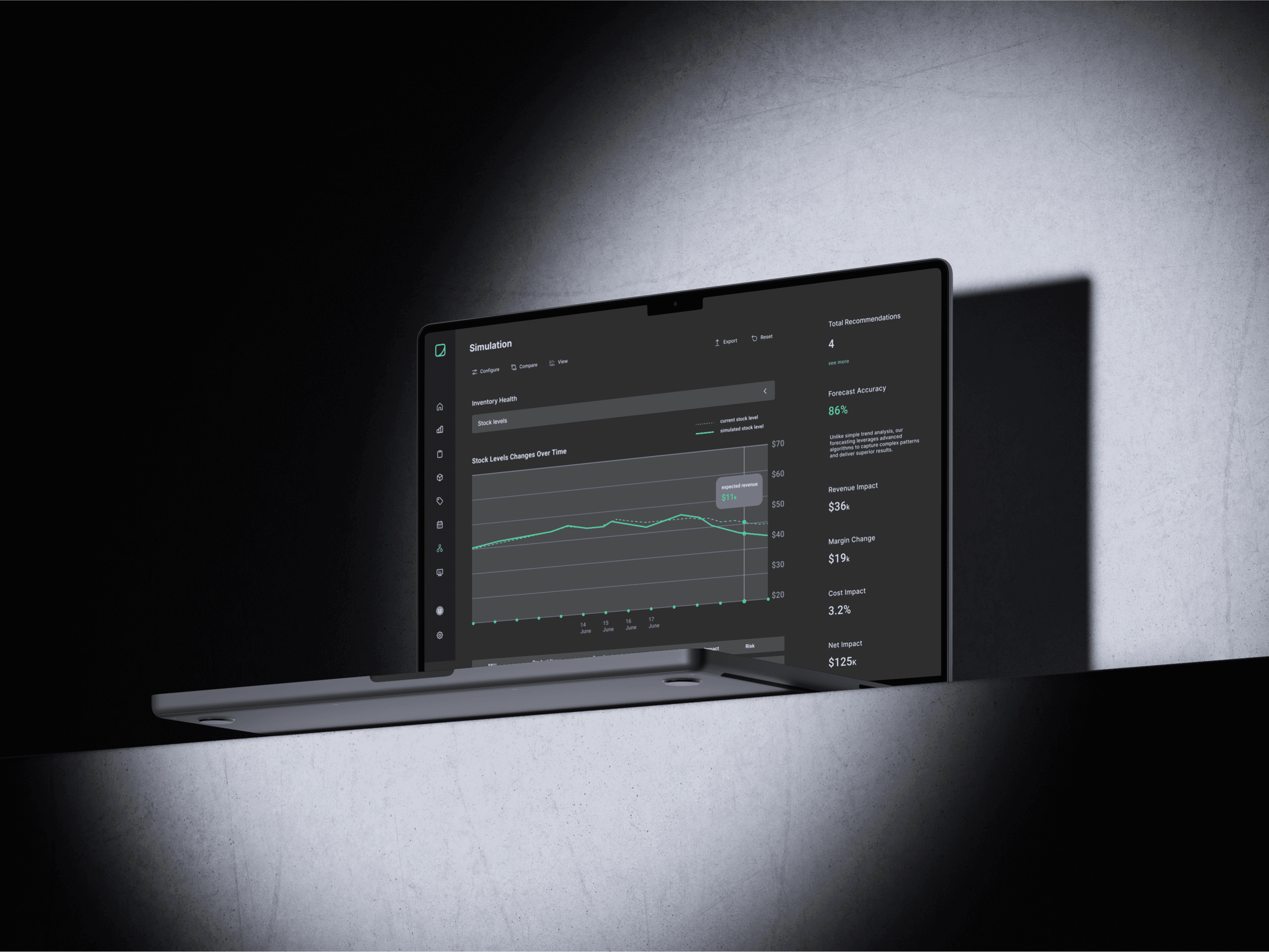
Supply Chain Simulation Engine
Supply Chain Simulation Engine
Supply Chain Simulation Engine
Compare unlimited scenarios side by side to make confident decisions under pressure
Compare unlimited scenarios side by side to make confident decisions under pressure
My Role
My Role
My Role
Design Lead
Design Lead
Design Lead
Timeline
Timeline
Timeline
Q3 2024
Q3 2024
Q3 2024
Team
Team
Team
1 Designer, 4 Data Scientist , 2 DevOps, CTO, CEO
1 Designer, 4 Data Scientist , 2 DevOps, CTO, CEO
1 Designer, 4 Data Scientist , 2 DevOps, CTO, CEO
Background
Background
Background
Background
Supply chain teams rely on demand forecasting to plan inventory, pricing, and operations.
The company built a powerful AI engine that could predict sales with high accuracy. But forecasts existed in the backend, but there was no interface to make them actionable for users. Without a clear way to visualize predictions, even experienced professionals couldn't confidently act on the data
Challenge
Build a simulation tool that lets users test "what-if" scenarios
Design for two distinct user groups: supply chain managers and small business owners
Translate complex AI outputs into an interface that feels intuitive, not overwhelming
Validate the product before committing to full development
Background
Supply chain teams rely on demand forecasting to plan inventory, pricing, and operations.
The company built a powerful AI engine that could predict sales with high accuracy. But forecasts existed in the backend, but there was no interface to make them actionable for users. Without a clear way to visualize predictions, even experienced professionals couldn't confidently act on the data.
Challenge
Build a simulation tool that lets users test "what-if" scenarios before making real decisions
Design for two distinct user groups: supply chain managers at large organizations and small business owners
Translate complex AI outputs into an interface that feels intuitive, not overwhelming
Validate that the product solves a real need before committing to full development
Background
Supply chain teams rely on demand forecasting to plan inventory, pricing, and operations.
The company built a powerful AI engine that could predict sales with high accuracy. But forecasts existed in the backend, but there was no interface to make them actionable for users. Without a clear way to visualize predictions, even experienced professionals couldn't confidently act on the data.
Challenge
Build a simulation tool that lets users test "what-if" scenarios
Design for two distinct user groups: supply chain managers and small business owners
Translate complex AI outputs into an interface that feels intuitive, not overwhelming
Validate the product before committing to full development
Research
& Discovery
Research
& Discovery
Research & Discovery
I led user interviews with 12 supply chain professionals, including existing dashboard users and potential customers through design partnerships, to understand current workflows and pain points around scenario planning.
I led user interviews with 12 supply chain professionals, including existing dashboard users and potential customers through design partnerships, to understand current workflows and pain points around scenario planning.
Key findings
Key findings
78% of critical decisions are triggered by unexpected market changes, not planned reviews
Users strongly preferred visual comparison (87%) over numerical tables when evaluating scenarios
92% reported making decisions under significant time pressure, requiring fast & confident analysis
Mental model insight: Users think in terms of "baseline vs. alternatives" rather than isolated scenarios
78% of critical decisions are triggered by unexpected market changes, not planned reviews
Users strongly preferred visual comparison (87%) over numerical tables when evaluating scenarios
92% reported making decisions under significant time pressure, requiring fast & confident analysis
Mental model insight: Users think in terms of "baseline vs. alternatives" rather than isolated scenarios
Competitive Analysis
Tool
Tool
Tool
Strengths
Strengths
Strengths
Weaknesses
Weaknesses
Weaknesses
SAP IBM
SAP IBM
Powerful scenario creation
Powerful scenario creation
No side-by-side comparison
No side-by-side comparison
Oracle SCM Cloud
Oracle SCM Cloud
Strong forecast accuracy
Strong forecast accuracy
Limited emergency response
Limited emergency response
Tableau / Power BI
Tableau / Power BI
Excellent visualization
Excellent visualization
No built-in scenario planning
No built-in scenario planning
While forecasting tools provide predictions, none offered integrated, comparative scenario testing within the main workflow.
While forecasting tools provide predictions, none offered integrated, comparative scenario testing within the main workflow.
Strategic Decisions
Strategic Decisions
Based on research findings, I aligned stakeholders on three design principles:
Built into the existing workflow: reduce context switching
Visual comparison as the default view: support fast, confident decisions
Emergency response mode: address the 78% of decisions triggered by unexpected events
Based on research findings, I aligned stakeholders on three design principles:
Built into the existing workflow: reduce context switching
Visual comparison as the default view: support fast, confident decisions
Emergency response mode: address the 78% of decisions triggered by unexpected events
Based on research findings, I aligned stakeholders on three design principles:
Built into the existing workflow: reduce context switching
Visual comparison as the default view: support fast, confident decisions
Emergency response mode: address the 78% of decisions triggered by unexpected events
Key Features
Guided Wizard Flow
Key Features
Guided Wizard Flow
Key Features
Guided Wizard Flow
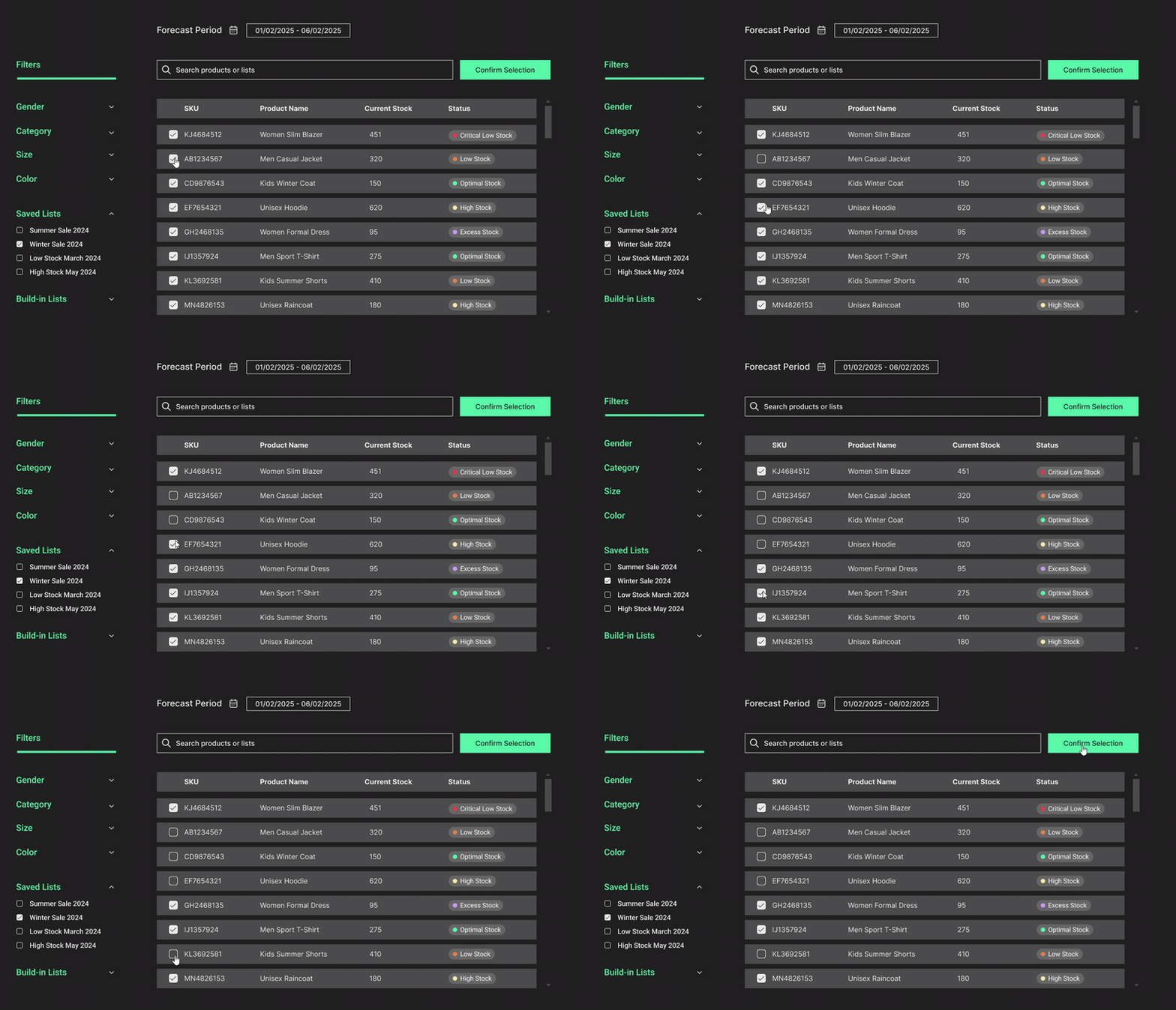
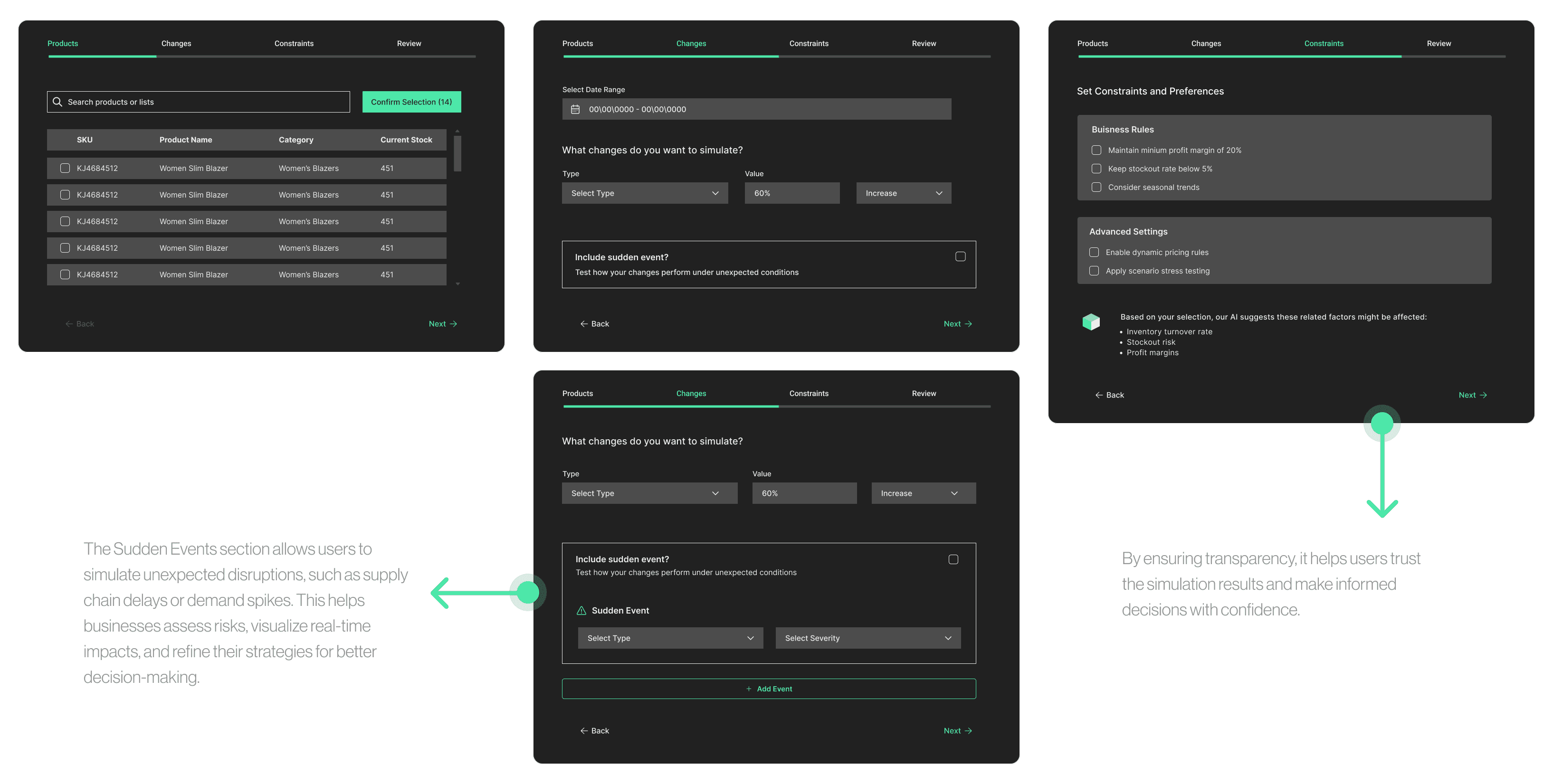
To reduce cognitive load when configuring complex simulations, I designed a step by step wizard that breaks parameter selection into logical stages.
Users move from product selection → constraint setting → scenario generation, with contextual guidance at each step.
Comprehensive Simulation
Comprehensive Simulation
Comprehensive Simulation
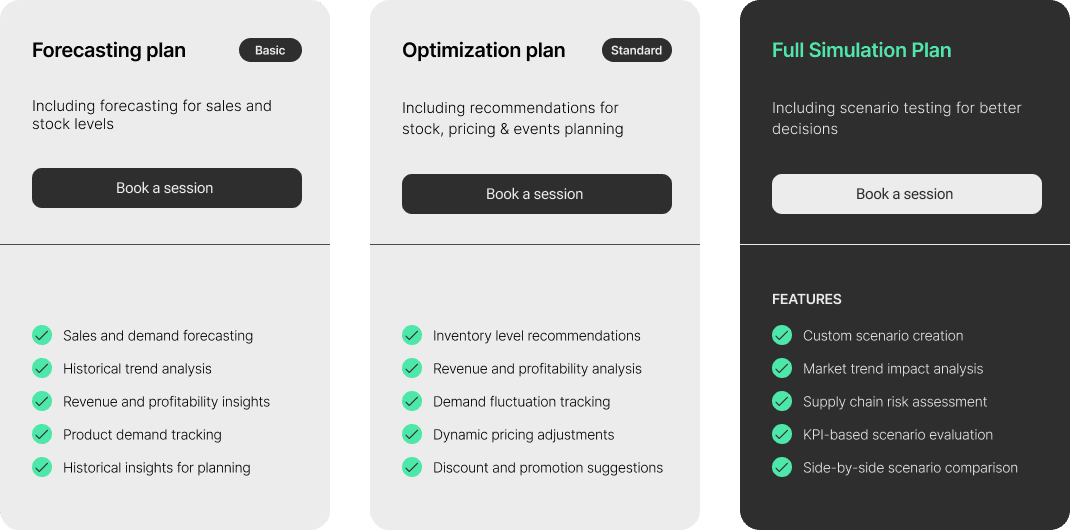
I designed a system that lets users configure complex simulations by adjusting any parameter — pricing, inventory levels, demand forecasts, supply timelines, and risk scenarios.
Users define their inputs through a structured process, then the AI engine generates predictions based on those parameters, enabling multiple scenarios exploration across their entire supply chain.
I designed a system that lets users configure complex simulations by adjusting any parameter — pricing, inventory levels, demand forecasts, supply timelines, and risk scenarios.
Users define their inputs through a structured process, then the AI engine generates predictions based on those parameters, enabling multiple scenarios exploration across their entire supply chain.
Multi-Layer Visualization
Multi-Layer Visualization
Multi-Layer Visualization
Users see simulation results through two integrated views:
Dynamic graphs showing trends and projections over time
Detailed data tables for granular analysis
This layered approach supports both quick scanning and deep analysis, depending on decision context.
Users see simulation results through two integrated views:
Dynamic graphs showing trends and projections over time
Detailed data tables for granular analysis
This layered approach supports both quick scanning and deep analysis, depending on decision context.
Scenario Management
& Comparison
Scenario Management
& Comparison
Scenario Management
& Comparison
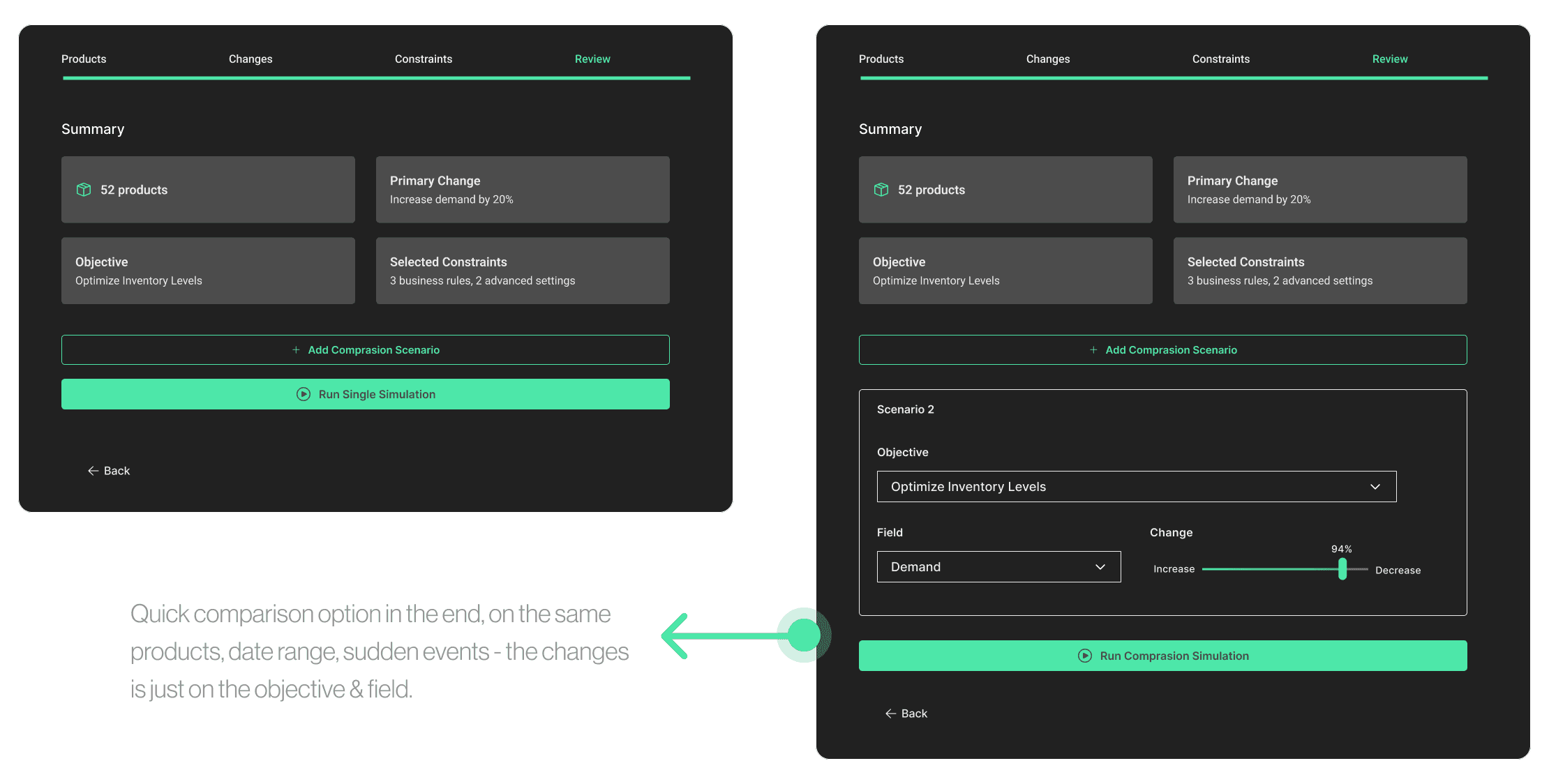
Built a system that lets users create, save, and compare unlimited scenarios. Instead of mentally juggling alternatives or switching between tabs, users can place scenarios side by side to understand trade-offs and make confident decisions under pressure.
My design
Hierarchical filters enabling multi-dimensional analysis (time / product / location / performance)
Multi-select combinations with visual chips and saved presets
Real-time result count showing impact of each filter
My design
Hierarchical filters enabling multi-dimensional analysis (time / product / location / performance)
Multi-select combinations with visual chips and saved presets
Real-time result count showing impact of each filter
Result
Enabled multi-dimensional analysis that was impossible in Excel
Emergency Response Mode
Emergency Response Mode
Emergency Response Mode
I Created a fast-track interface for crisis situations, with pre-set templates for common disruptions (like supplier shutdown, demand spike, pricing pressure or corona virus).
Users can rapidly configure response strategies when time is critical, addressing the
78% of decisions triggered by unexpected events.
I Created a fast-track interface for crisis situations, with pre-set templates for common disruptions (like supplier shutdown, demand spike, pricing pressure or corona virus).
Users can rapidly configure response strategies when time is critical, addressing the 78% of decisions triggered by unexpected events.
Problem
The algorithm forecasted and recommended, but couldn't see what actually happened. Users missed critical signals when reality diverged from predictions.
Impact
Impact
Impact
Product Validation
The simulation feature became a central selling point in customer conversations, demonstrating clear market demand for integrated scenario planning. Early adoption showed strong signals:
Existing customers began incorporating simulations into their decision-making workflows
Prospective customers expressed interest specifically because of the simulation capabilities
The feature addressed a validated gap: enabling "what-if" analysis without leaving the main workflow
Key Learnings
Visual comparison drives confidence: Users made faster decisions when they could see scenarios side by side rather than mentally compare alternatives
Workflow integration is non negotiable: Even powerful features fail if they disrupt established workflows; embedding simulation directly into the dashboard was essential for adoption
Emergency scenarios require different UX: Crisis decision-making demands streamlined interfaces with pre-set templates, not complex configuration wizards
Product Validation
The simulation feature became a central selling point in customer conversations, demonstrating clear market demand for integrated scenario planning. Early adoption showed strong signals:
Existing customers began incorporating simulations into their decision-making workflows
Prospective customers expressed interest specifically because of the simulation capabilities
The feature addressed a validated gap: enabling "what-if" analysis without leaving the main workflow
Key Learnings
Visual comparison drives confidence: Users made faster decisions when they could see scenarios side by side rather than mentally compare alternatives
Workflow integration is non negotiable: Even powerful features fail if they disrupt established workflows; embedding simulation directly into the dashboard was essential for adoption
Emergency scenarios require different UX: Crisis decision-making demands streamlined interfaces with pre-set templates, not complex configuration wizards
